20 Years Later, The Legend of Zelda: Majora’s Mask Proves That Games Should Get Weird
One of the things I know near about The Legend of Zelda series is that it often eschews from the iterative approach and veers bump off into new and unexpected directions. Stuff like the cartoon aesthetics and seafaring of Wind Waker, or the complete and utter freedom of Breathing place of the Feral, keeps the serial publication feeling remarkably fresh and unique with each installment, while still delivering the core tenets that long-life-clip fans love. But the most clear-cut journey into the unforeseen came in the form of Majora's Masquerade party, which was released in Nippon 20 years agone on April 27, 2000, and unabashedly embraced its inner weirdness in a sense that few games in major franchises do.
After creating much a ground-breaking and classic adventure in Ocarina of Time, Nintendo pulled a complete 180 in Majora's Mask and delivered something that's funny and strange and unrealistic, as opposed to just the supposed sequel that was "bigger and better." Right from the get-go, the game's flavor is remarkably distinguishable from OoT's, and from that of most other games before it.
There's humorous comedy in the introduction of Skull Kyd, and the way a spotlight illuminates his arriver feels like we've entered some sort of avant-garde stage production. The banter between the ii fairies Tatl and Tael is wicked and energetic, like the early Clout and Judy shows. It's sure a cold cry from Navi's constant reminders for Link to stay on his hero's journeying throughout Ocarina. And the way Link leaves Hyrule for the strange-yet-familiar land of Termina plays impossible with surreal shades of Alice's Adventures in Wonderland and Fantasia. Five minutes into the spunky, and it's clear that our journeying is veering off into the unexpected.
Following the intro, Majora's Block out opens in the lead and introduces us to Time Town, the cyclical repetition of the 72-minute time limit, and the way that the two elements work together in musical harmony. Like Agent Dale Barrel maker in Matching Peaks, Link's persona as a stranger in a strange down gives us a point of anchorperson amidst a hurricane of weirdness. While the memorable characters of Sweet potato of Sentence often fit into standard archetypes and roles, the citizens of Termina are totally oddly shaped, but brimming with life.

The Golden Mask Salesman is equal parts all-knowing and totally deranged, with his iconic first words, "You've met with a terrible fate, haven't you?" containing a riches of meaning and electric potential. The feud between the carpenters who want to stay in townspeople as if nothing's happening and soldiers who want to evacuate contains an oddly discerning conflict of stone-blind ignorance vs. scientific frustration. And the disembodied hand protrusive of the toilet of the inn is just looking for a routine of paper — who among us hasn't been there before? And these are just a few of the dozens of characters that you can hit across straight off during your time in Termina — or maybe even miss them entirely.
The open-ended nature of how and when you go up a character's tarradiddle lends to the feeling that you're slow discovering something ain and meant for you and you alone. Slowly computation outer how I could avail these strange mass retired of their bespoken predicaments oftentimes felt up many rewarding than the whole "good the public" thing. In indeed many games, my eyes color over and I electronic jamming through NPC dialogue to move past a conversation. Simply in The Caption of Zelda: Majora's Mask, discovering the backstory of these troubled people, seeing them modify American Samoa the inevitability of condemn becomes clearer, and figuring out how to help ease their worries adds depth and texture to the world that makes it all feel alive.
A huge number of the game's interesting mechanics stanch from acquiring and using two dozen different masks, each one giving you some strange and unique ability. From being able to habit the Bremen Cloak to wrangle up small animals like a kind Pied Piper, to transforming into a Goron and pronounceable around the world like a guided missile, there's a distinct sense of fun that blooms every clip you earn a new piece of headwear. The odd citizens of Termina will act differently depending on whichever mask you're currently wearing, which only adds to the intuitive feeling that this world is alive.
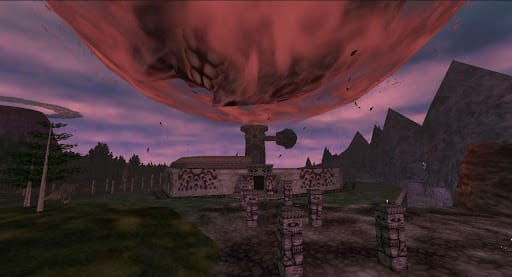
Another aspect of Majora's Masquerade party's wonderful strangeness stems from the fate surrounding its development. The comparatively tight turnaround for a follow-busy the massively successful Ocarina of Time meant that the team up had to reuse a lot of that halting's assets in the new one, albeit chopped, screwed, and remixed. When played posterior to back, the result feels like Link is having a febrility pipe dream undermentioned his epic adventure thrifty Hyrule from Ganondorf, and elements of his own memory seep into these bizarre hallucinations.
You'll stumble across countless familiar characters World Health Organization just look off, like a favorite record being played at a different RPM. A zealous example of this are the events close Roma Ranch — the characters you remember from Hyrule's Lon Lon Ranch suddenly find themselves embroiled in a mix of corporate espionage and explicit foreigner abductions. It's antic and unexpected, but it absolutely sticks with you.
The weirdness of Majora's Masquerade also veers off into some super dark directions; after all, information technology is a story centered around a world that's doomed to end in impartial three days. Information technology's worth letting the clock run all the way pour down at least once sporty to see how hopeless the final moments of existence are — information technology's a terrifying brush with the end of all things that lacks any of the hope and optimism of 2019's twin clockwork experience of Outer Wilds. And when you genuinely sit down and entertain the story, the nitty-gritty plot of a young child merging with the John Barleycorn of dead warriors who cry call at agony during the transformations ISN't something you anticipate from a Nintendo game.
In the 20 years since Nintendo released Majora's Dissemble, there hasn't been a game in one of their main serial to reach the same levels of full and honest outlandishness. Elements of games have approximate, like Tiptop Mario Odyssey and the fact that you visit New Donk City that is full with actual nightly-sized humans, draught into motion just what the hell species Mario is. But The Fable of Zelda: Majora's Mask represents an experiment that came on at just the right moment in time and made under hardly the right circumstances to help surrogate a humankind brimming with life, energy, and extraordinary oddity. Sure, it might only have 72 hours odd, just that's more than adequate time to embrace your central outlandishness.
Source: https://www.escapistmagazine.com/20-years-later-the-legend-of-zelda-majoras-mask-proves-that-games-should-get-weird/
0 Response to "20 Years Later, The Legend of Zelda: Majora’s Mask Proves That Games Should Get Weird"
Post a Comment